

How It Works
Universal Goods turns your physical products into phygitals — products with verifiable digital identities. You organise product data into a clear hierarchy, anchor critical records on-chain for tamper-proof verification, and share exactly what you choose with consumers and business partners. This page covers the core concepts you need before diving into the Quickstart or Guides.
The product hierarchy
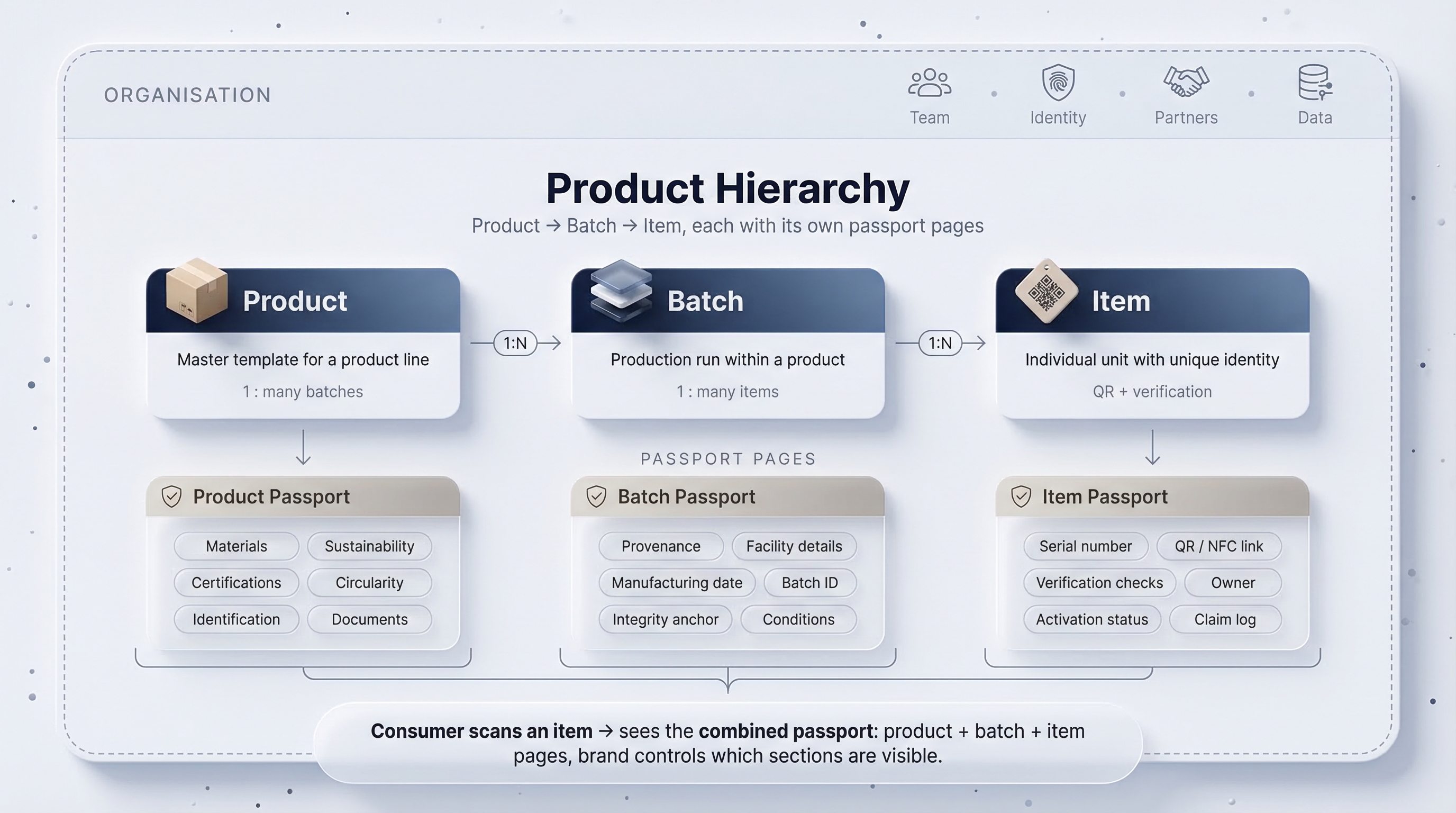
Your organisation contains your team, on-chain identity, partner connections, and all product data. Within it, products are organised into a three-level hierarchy:
- Product is a master template for a product line (e.g., "Premium Leather Handbag") with structured data sections for materials, provenance, sustainability, and certifications.
- Batch is a production run within a product line (e.g., "March 2026, Milan Factory"). Batches track manufacturing at the run level and can be finalised on the blockchain.
- Item is an individual tokenised unit within a batch. Each item gets a unique digital identity on the blockchain, a private key for verification, and an activation code for consumers.
Passports at every level
Every level has its own passport with data sections relevant to that level:
Passports at each level can also reference external records. A product passport can link to material passports, conformity records, and facility records. A batch passport can reference production records and test reports. These references mean the passport is a living document that grows richer over time as records are attached.
A consumer scanning an item's QR code sees the combined passport: product-level data inherited from above, batch-level production details, and item-specific identity and verification. You control exactly which sections are visible at each level.
How verification works
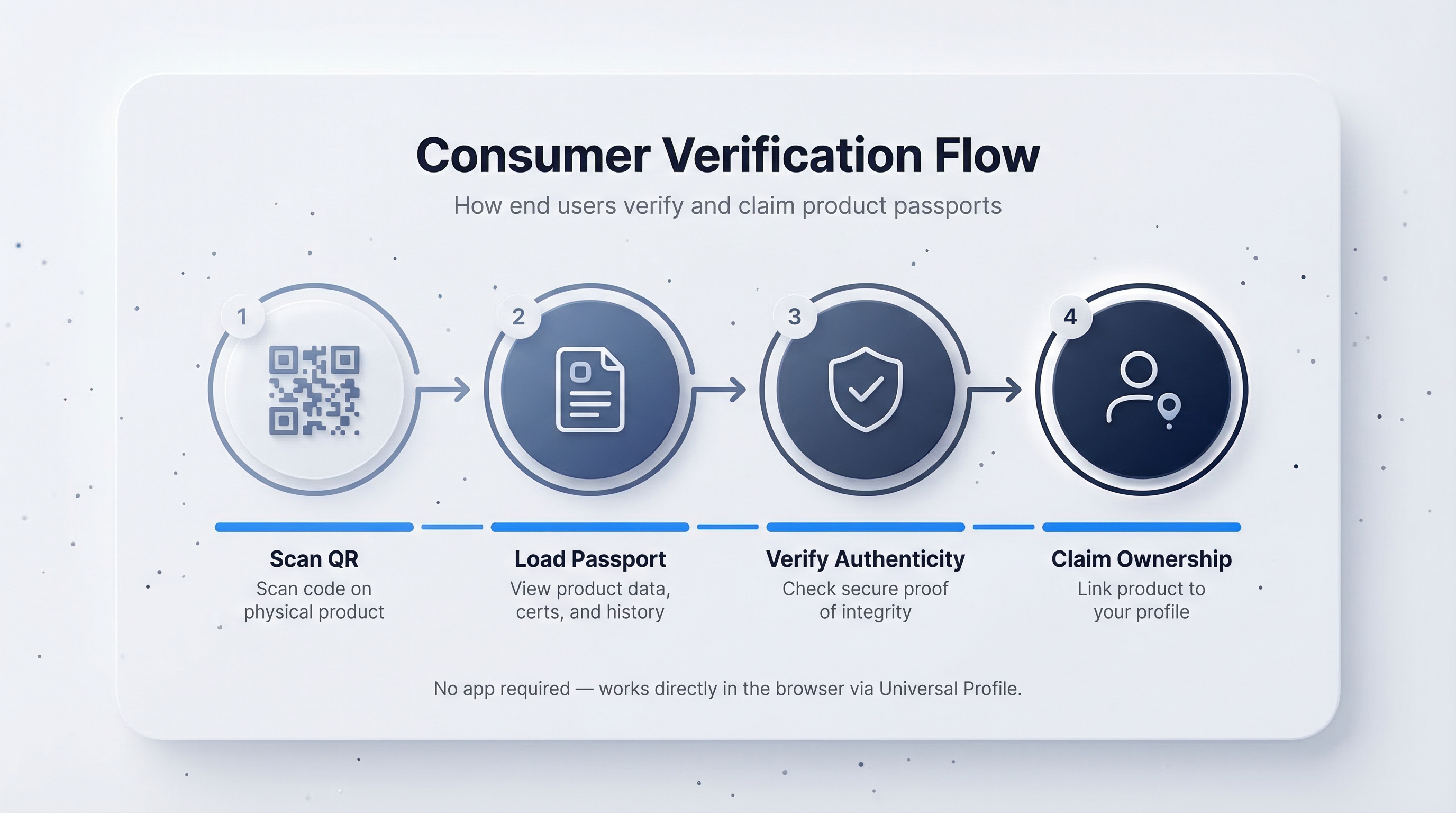
When someone encounters a product with a Universal Goods passport, verification follows four steps. Universal Goods calls this process Scan-to-Sign:
- Scan a QR code on the product (or click a link). It opens in a standard web browser.
- Discover the product passport: materials, certifications, origin, care instructions, whatever the brand chose to share.
- Verify automatically. The platform checks the on-chain record to confirm the data has not been tampered with and was issued by the claimed organisation. The result is a clear pass/fail indicator.
- Claim optionally. Associate the passport with a personal profile to keep a record of authenticated products.
The verification is cryptographic, but the experience is simple — a web page with a clear verified badge. No app, no account, no complexity.
Anyone with the QR code or link can verify a product. No app, no account, no blockchain knowledge needed.
The trust architecture
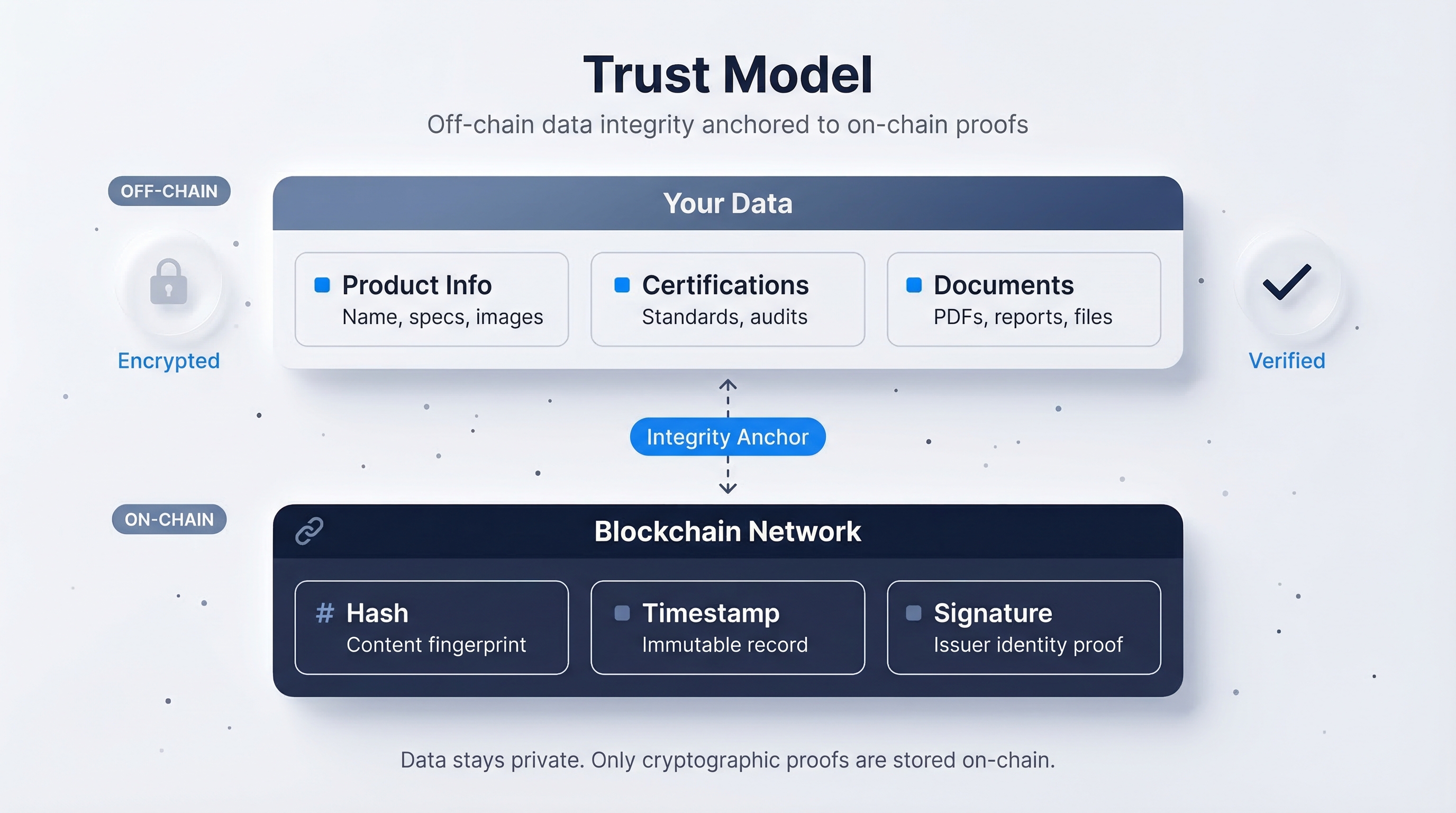
The platform uses a hybrid architecture that combines the best of traditional web applications with on-chain verification.
Off-chain is where the data lives. All operational data (product descriptions, images, certifications, material breakdowns, team management, partner exchanges) lives in conventional cloud infrastructure. Product data with images, PDFs, and structured records needs the performance, queryability, and flexibility of a modern database.
On-chain is where trust is anchored. At critical moments, the platform writes compact integrity references to the blockchain:
- Batch finalisation. The item list is frozen and a point-in-time snapshot of the current data is anchored on-chain. The anchor can be refreshed when data is updated.
- Item identity. Each item's on-chain address and its association with your organisation can be independently verified.
- Organisation identity. Your Universal Profile on the blockchain serves as a public, verifiable identity anchor.
When someone verifies a product, the system checks both layers: off-chain data provides the rich product story, on-chain anchors prove it has not been tampered with.
Working with partners
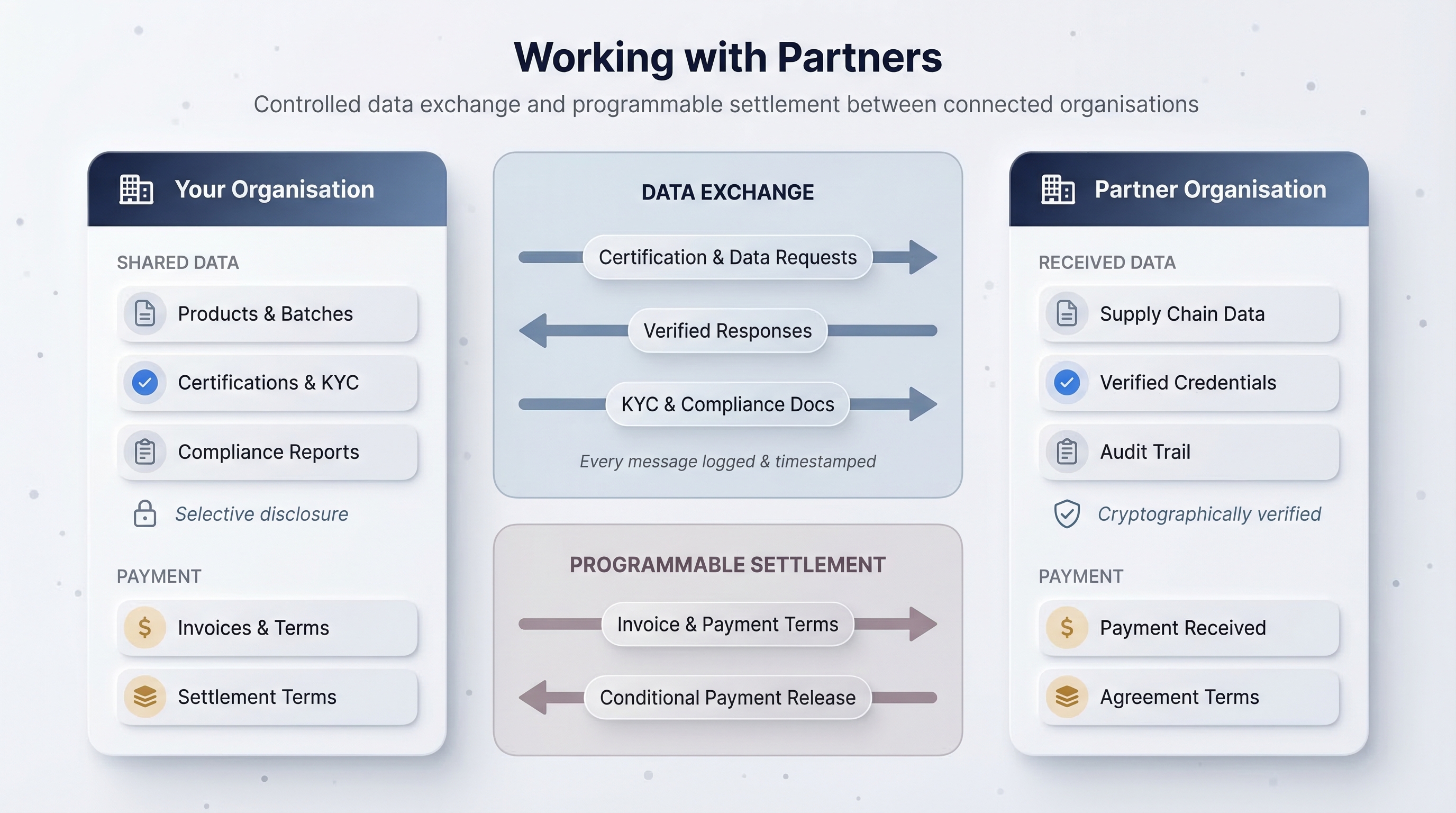
The platform provides structured channels for data and payment exchanges between connected organisations:
- Connect by exchanging invitations. Each connection has defined roles (supplier, buyer, service provider) that determine what each party can do.
- Exchange data through auditable channels: certification requests, KYC documentation, compliance reports, and supply chain records. The platform acts as a data escrow. You choose exactly which fields and documents to share, and nothing is exposed without explicit consent.
- Exchange payments with built-in escrow. Invoices, payment terms, and fund releases flow through the same connection, so financial and data obligations are tracked together.
- Control disclosure at every step. Each exchange is scoped to specific fields and documents. The platform never exposes data or triggers payment beyond what you have explicitly authorized.
Every exchange is logged and timestamped, creating an audit trail for compliance reviews and disputes.
Next steps
Now that you understand how the platform works:
- Quickstart: Create your first product and share a passport
- Guides: Step-by-step walkthroughs for every workflow